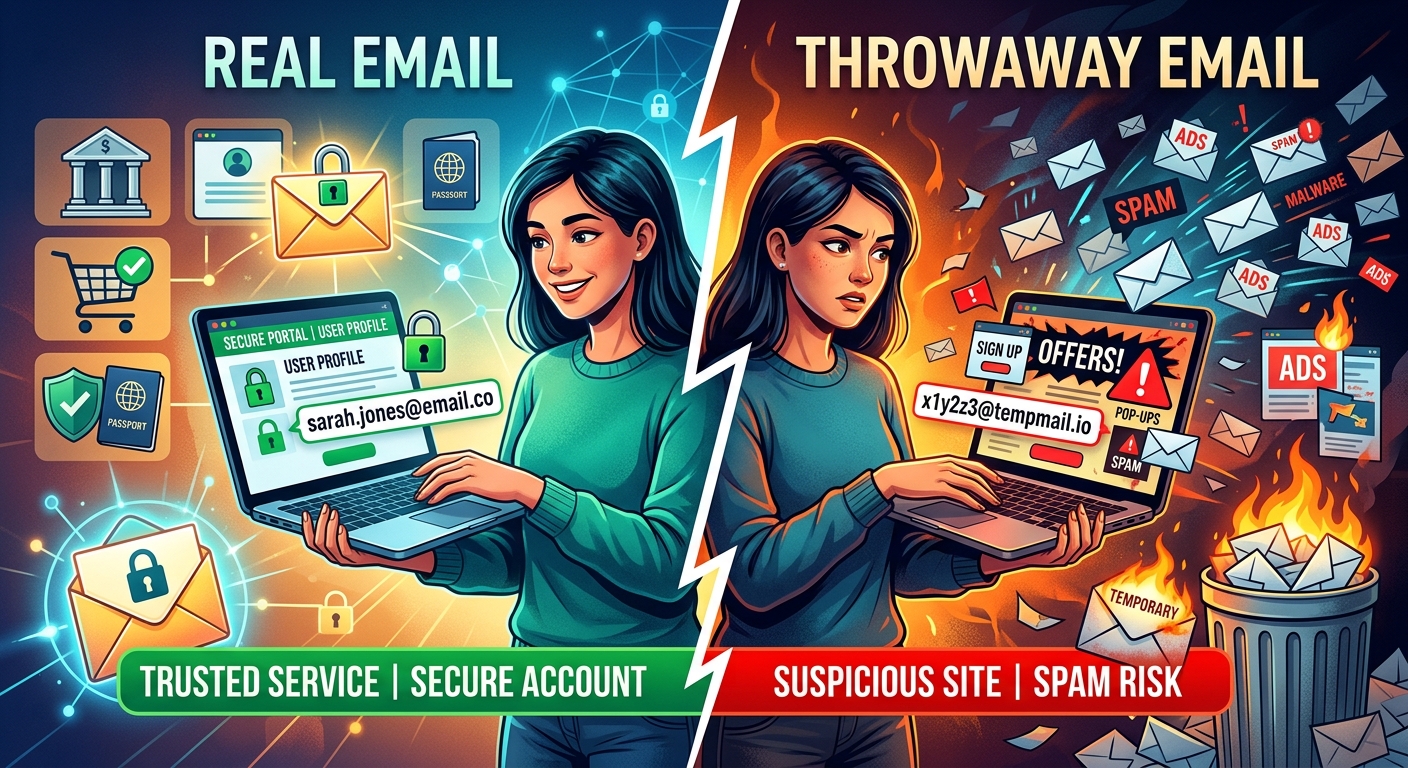
Your email address is more than a contact point. It functions as a key to your digital identity. Every time you hand it to a website, you are making a decision you cannot easily walk back. Some of those decisions serve you well. Others set off a chain of events that fills your inbox with spam, exposes you to phishing attempts, and lands your personal details on databases you never agreed to join. The good news is that with one clear framework, you can stop making that decision blindly.
Your Inbox Has a Trust Threshold
Not every website deserves your real email address. Trusted services like banks, healthcare providers, and government portals earn it because they need it to protect your account and send you critical information. Low-stakes signups like free trials, random newsletters, and one-off downloads do not. Using a throwaway address for those interactions keeps your real inbox clean, reduces your exposure to data brokers, and limits the damage if a site is ever breached.
How Email Addresses End Up on Spam Lists
When you enter your email on a sign-up form, you rarely know exactly where it goes next. Many websites share data with advertising partners listed deep in their privacy policies. Those partners may share it with others. Within weeks, your address can travel from a single retailer to dozens of marketing platforms without you taking any further action.
Data brokers are a central part of this pipeline. These are companies that collect, combine, and sell personal information, including email addresses, names, phone numbers, and behavioral data. You may have never heard of them, but they likely have a profile on you already. That profile grows each time you fill out a form on an unfamiliar site. The agency responsible for consumer protection and competition has published guidance on data broker oversight that reveals how widespread this industry is and how little most people know about it.
Some sites also scrape email addresses from public forums, comment sections, and social profiles. Others compile them through contests and sweepstakes where the fine print permits broad data sharing. The mechanisms vary, but the outcome is consistent: your address spreads further than you intended, and you have almost no way to trace where it went.
What a Single Careless Signup Can Trigger
Spam is the most visible outcome. You start receiving promotional emails from companies you have never heard of, and the volume compounds as your address circulates between lists. What starts as two or three unfamiliar senders can balloon into dozens within a few months.
Phishing attacks are more dangerous. Criminals buy harvested email lists and use them to send convincing messages that appear to come from your bank, a delivery service, or a government agency. The goal is a click, a login, or a wire transfer. The more websites that hold your real address, the more angles an attacker has available to try.
Data breaches add a third layer of risk. Even a company you trusted can lose your data in a breach. Once your address appears in a leaked database, it gets tested automatically against other platforms. Credentials from old breaches still circulate years later, and attackers run them against new targets constantly. A careless signup at a site that later suffers a breach does not just mean more spam. It can mean a compromised account somewhere else entirely.
A Tiered Approach to Protecting Your Inbox
Treating every sign-up form the same way is not realistic. Some services need your real address to keep you safe and informed. Others have no good reason to hold it long-term. A tiered approach lets you make faster decisions without second-guessing every form you encounter.
Tier One: Services That Earn Your Real Address
Some services genuinely need your real email address to function properly and to protect you. These are the institutions where a missed message could have meaningful financial, medical, or legal consequences:
- Banks, credit unions, and investment accounts
- Health insurance portals and medical providers
- Government services including tax filing, benefits, and licensing agencies
- Primary employer systems and essential workplace tools
- Insurance providers and utility companies
- Any service where email is the only path to account recovery
These organizations typically operate under legal obligations around data use. Contact through your real email may be the only way you receive fraud alerts, appointment reminders, or security notifications. Substituting a throwaway here could mean missing something that genuinely matters to your financial, physical, or legal wellbeing.
Tier Two: Situations Worth Thinking Through
Some services fall into a middle ground. A well-known retailer you shop with regularly, a paid software subscription, or a newsletter from a publication you read every week may be worth your real address if you want their communications and have reasonable confidence in their data practices. The question to ask is a simple one: do I want ongoing contact from this company, and do I believe they handle my information responsibly? If the answer is yes to both, your real address is a sensible choice. If either feels uncertain, a secondary personal address that you check occasionally works well for this category. You stay reachable without exposing your primary inbox.
Tier Three: Throwaway Territory
Free trials from services you are testing once, one-off purchases from unfamiliar retailers, contest entries, gated content downloads, and newsletters from sites you have only just discovered all belong here. The common thread is low commitment combined with high uncertainty. You do not know these sites well enough to trust them with your real identity, and you do not need sustained contact from them. This is where a throwaway address earns its place.
Deciding at a Glance: Real Email vs. Throwaway
| Situation | Use Your Real Email? | The Reason |
|---|---|---|
| Bank or credit union account | Yes | Security alerts and account recovery depend on it |
| Healthcare portal or medical office | Yes | Appointment reminders and test results need a reliable inbox |
| Government service or tax platform | Yes | Legally required notices must reach you |
| Established retailer you buy from regularly | Likely yes | Order confirmations and return notices are useful to receive |
| Free trial on an unfamiliar platform | No | High risk of list-sharing; one confirmation email is all you need |
| One-time download or gated resource | No | You need a single access link, not an ongoing relationship |
| Contest or sweepstakes entry | No | Data sharing in the fine print is nearly guaranteed |
| Newsletter from a site you just found | No | Read a few issues first; use your real address only once you trust it |
The Disposable Email Option: Lowest Friction, Immediate Results
A disposable email address is a temporary inbox that lets you complete a sign-up, receive a confirmation link or access code, and then walk away. No follow-up messages reach your real inbox. No data broker can connect that address to your actual identity through cross-site tracking. When the address expires, the thread simply ends.
Using a disposable email service requires no account creation, no configuration, and no technical setup. You visit the site, copy a randomly generated address, paste it into the sign-up form, retrieve the confirmation message from the temporary inbox, and move on. The whole process takes under a minute. Your real inbox never even knows the interaction happened.
This approach works particularly well when you are accessing a resource hidden behind a mandatory email gate, testing a platform before committing to a paid plan, or claiming a one-time promotion from a site you have no intention of revisiting. It also protects you during sign-ups where no privacy policy is visible and you genuinely cannot tell what happens to your contact details next. Disposable addresses are not a universal fix. Some platforms block them outright, and they are clearly not suited to services where you need ongoing contact. But for low-stakes signups, they are the lowest-effort protection you can put in place without setting up aliases, creating extra accounts, or learning any new tools.
Building Your Personal Email Strategy
Putting this framework into practice does not require a major overhaul. A few concrete steps move you most of the way there, and each one builds on the last:
- Audit your current inbox. Search the word "unsubscribe" in your email client and count how many distinct senders appear. That number often reveals how widely your address has already spread.
- Set up a secondary personal address. Use a free email account as a buffer for mid-tier signups. Check it occasionally and unsubscribe from anything you do not recognize.
- Bookmark a disposable email service. Having one ready in your browser means you actually use it in the moment, before the temptation to just enter your real address and be done with it.
- Apply the tier test before every form. Ask yourself one question: do I need ongoing contact from this company? If not, reach for the secondary or throwaway address.
- Follow up on data broker opt-outs. Reducing your existing exposure matters even after you start protecting your address more carefully going forward. Many brokers offer opt-out pages, and working through them reduces the profile they hold on you.
None of these steps requires technical knowledge. They require only the habit of pausing for two seconds before entering your email address anywhere new.
Your Inbox Is a Record of Every Trust Decision You Have Made
The state of your inbox reflects every form you have ever filled out. Each time you handed over your real email address to a site that did not deserve it, you added one more thread to a web that is genuinely hard to untangle later. Spam filters catch some of it. Unsubscribing clears a little more. But the underlying exposure, your address sitting in third-party databases and marketing lists, does not go away just because you stopped seeing the emails.
The decisions you make from today forward shape what arrives tomorrow. You do not need to fix everything at once. Applying the tier test to new signups is the change that compounds fastest. Trusted services get your real address. Unfamiliar or low-stakes sites get a throwaway. That framework takes seconds to apply, and over time it produces a noticeably cleaner inbox, fewer unsolicited messages, and a meaningfully smaller footprint in systems you never consented to be part of in the first place.
Continue reading
- How to Protect Your Inbox from Spam, Phishing, and Data BrokersThe previous field note.